
- Progression-free survival (PFS) for casdatifan plus anti-PD-1 in the first-line (1L) setting exceeded third-party benchmarks* for the approved anti-PD-1 plus anti-CTLA-4 regimen (ipilimumab plus nivolumab) and is similar to benchmarks for approved anti-PD-1 plus TKI regimens; the Phase 3 PEAK-20 study evaluating casdatifan plus ipilimumab and nivolumab is on track to start by year-end.
- PFS and overall survival (OS) in the second-line (2L) cohort evaluating casdatifan plus cabozantinib substantially exceeded benchmarks for cabozantinib monotherapy, including in patients who had previously progressed on TKIs; the ongoing Phase 3 PEAK-1 study is evaluating the same combination in the same patient population.
- An unprecedented nearly three-year median OS was reached in heavily pre-treated kidney cancer patients (majority third-line plus [3L+]) in the pooled monotherapy cohorts, exceeding the benchmark for the only approved HIF-2α inhibitor by more than one year; these data reinforce the potential for robust and durable HIF-2α inhibition to deliver a survival benefit across lines of therapy and support plans for a registrational trial to evaluate the combination of casdatifan plus tivozanib.
HAYWARD, Calif.--(BUSINESS WIRE)--Arcus Biosciences, Inc. (NYSE:RCUS), a clinical-stage, global biopharmaceutical company focused on developing differentiated molecules and combination therapies for the treatment of cancer and immune diseases, announced new data at an investor event in New York City from the ARC-20 platform study, which is evaluating casdatifan, an investigational next-generation HIF-2α inhibitor, alone or in combination, as a first-, second- and late-line treatment for clear cell renal cell carcinoma (ccRCC).

“Across the RCC treatment continuum, and in every setting in which it has been studied, casdatifan has shown rapid disease control, a meaningful impact on survival, and was tolerable, both alone and in combination with standard-of-care therapies,” said Dr. Rana McKay, professor of medicine, urology, and radiation medicine, associate director of clinical sciences, at the UC San Diego Moores Cancer Center. “These are the attributes that matter most to physicians and patients.”
“We are executing on a plan to develop casdatifan as a backbone therapy for all ccRCC patients,” said Richard Markus, M.D., Ph.D., chief medical officer at Arcus Biosciences. “The disease control that has been observed for casdatifan plus anti-PD-1 in the first line, the remarkable benefit that has been observed for patients in the second line, even after progressing on prior TKI treatment, and unprecedented three-year median overall survival from casdatifan monotherapy in patients who had progressed on multiple prior therapies reveal for the first time the potential associated with deep and durable HIF-2α inhibition. We are on track to initiate our second registrational trial in ccRCC, the first-line PEAK-20 study, by the end of this year. This study is enabled by the strong dataset we have generated in the first-line setting.”
New data were presented from several cohorts of the ARC-20 study, which showed that every patient has the opportunity to benefit from casdatifan across each line of therapy over the course of their care. All cohorts had a data cut-off (DCO) of Sept. 4, 2026, and the data are summarized below. A detailed analysis can be accessed in a corporate deck published on the company’s website.
First-line TKI-free combinations:
-
Casdatifan plus anti-PD-1 zimberelimab (11.5 months of median follow-up)
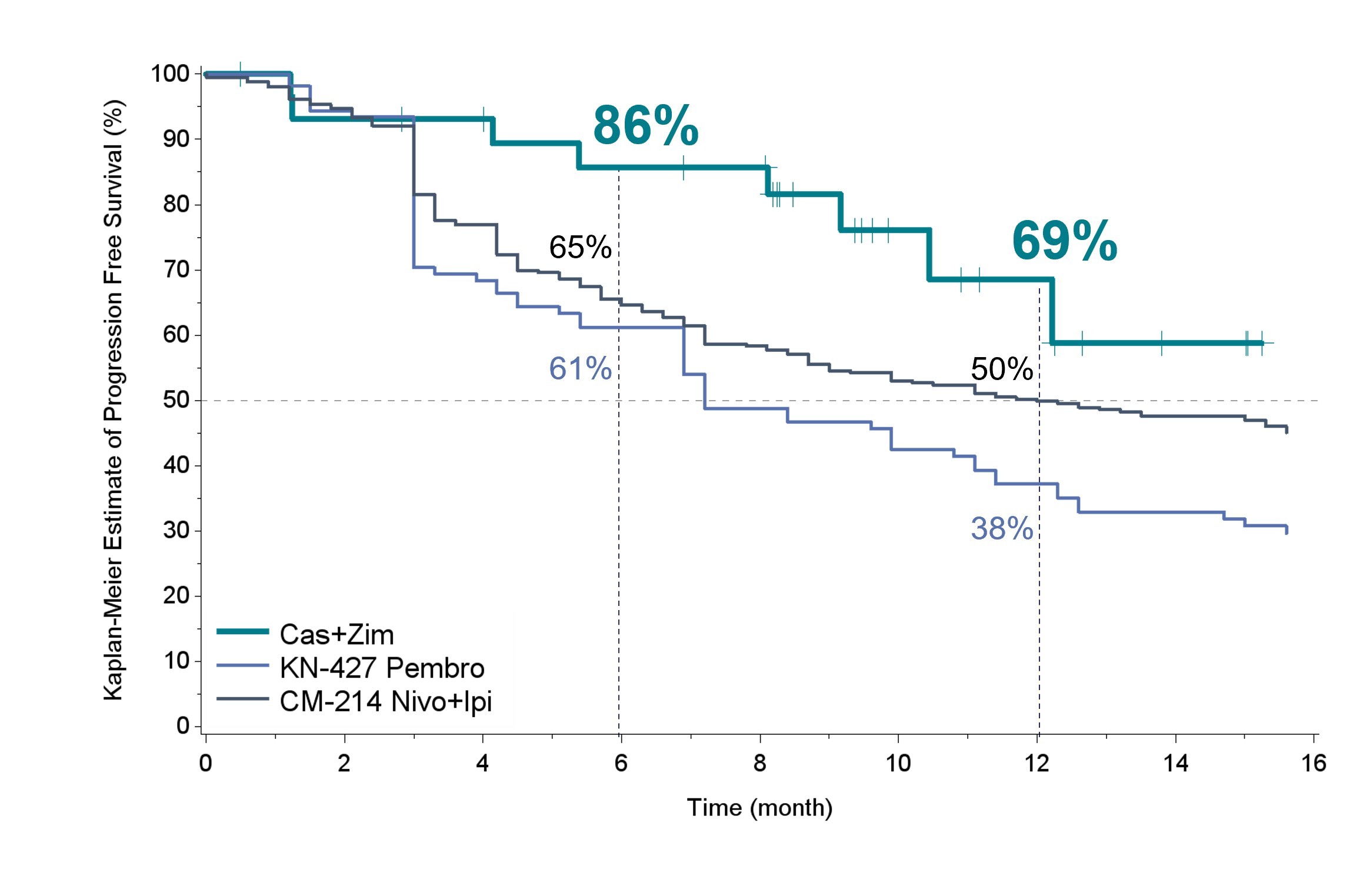
- Landmark PFS values of 86% and 69% were observed at 6 and 12 months, respectively in this cohort (n=30), which far exceeded benchmarks for anti-PD-1 (pembrolizumab) monotherapy (61% and 38%) and the standard-of-care anti-PD-1 plus anti-CTLA-4 (ipilimumab and nivolumab) combination (65% and 50%) in this setting (Figure 1). These landmark values also compare favorably with benchmarks for approved anti-PD-1 plus TKI regimens.
- A 50% confirmed objective response rate (cORR) and 6.7% (n=2) rate of primary progression (progression at or before first scan) were observed, indicating early tumor control. These data compare favorably with benchmarks for pembrolizumab (36% cORR and 30% primary progression) and the ipilimumab and nivolumab combination (39% cORR and 20% primary progression) in this setting.
- No unexpected safety signals were observed at the time of DCO (n=30). The regimen has shown safety data that are consistent with those observed in other cohorts or prior studies of each molecule.
-
Casdatifan plus ipilimumab plus zimberelimab (3 months of median follow-up)
- Only one patient experienced primary progression (4%, n=24 with at least one scan).
- No unexpected safety signals were observed at the time of DCO (n=31).
- Safety data from this cohort are expected to support initiation of PEAK-20, the planned 1L registrational trial evaluating casdatifan plus ipilimumab plus nivolumab, expected to start in the fourth quarter of 2026.
Second-line casdatifan plus cabozantinib combination (21.3 months of median follow-up):
- A 14.5-month median PFS (mPFS) was reached in patients (n=43) treated with casdatifan plus cabozantinib, far exceeding benchmarks for cabozantinib in this setting (~10 months mPFS). The 18-month landmark OS was 77% for the combination (compared to ~60% for cabozantinib benchmarks in this setting [Figure 2]), cORR was 44% and primary progression was 5%.
- Casdatifan plus cabozantinib demonstrated impressive efficacy, including in patients who had progressed on a prior TKI therapy. TKI-pretreated patients represent approximately 60% of 2L patients in current practice and derive diminished benefit from subsequent TKI therapies. The efficacy of casdatifan plus cabozantinib was similar to that of patients who had not received a TKI in their prior treatment.
- No unexpected safety signals were observed at the time of DCO (n=44). The regimen has shown safety data that are consistent with those observed in other cohorts or prior studies of each molecule.
- Arcus is evaluating casdatifan plus cabozantinib, the most prescribed TKI, for the 2L treatment of ccRCC in the ongoing registrational Phase 3 PEAK-1 study.
Late-line casdatifan monotherapy (28 months of median follow-up):
- A 35-month median OS (mOS), 13-month mPFS and 36% cORR were observed in the four pooled monotherapy cohorts (n=121), which evaluated casdatifan in heavily pre-treated patients with metastatic ccRCC (52% had received at least three prior lines of therapy), including both an anti-PD-1 and a VEGFR TKI. The four pooled monotherapy cohorts included: 50mg once daily (QD), 50mg twice daily (BID), 100mg QD (tablet) and 150mg QD. Casdatifan demonstrated improvements across each of the key efficacy measures relative to data from benchmark studies with a first-generation HIF-2α inhibitor (Figure 3).
- PFS data were similar whether patients had received one, two or three prior TKI-inclusive treatments, in contrast to what has been reported for the only approved HIF-2α inhibitor, which showed an inverse correlation between efficacy and more prior TKI-inclusive therapies in a similar patient population (LITESPARK-013).
- No unexpected safety signals were observed, and casdatifan showed acceptable and manageable adverse events across all doses.
- Arcus plans to initiate a registrational trial evaluating casdatifan plus tivozanib compared to tivozanib.
Arcus is hosting an in-person and virtual investor event in New York today, beginning at 5:30 AM PT / 8:30 AM ET, to review the new casdatifan data. Investors may register and log in to the live webcast using the following link: https://event.summitcast.com/view/oP6P82VnbjK87kUbV5QALF/guest_book?session_id=WJm4z43QhGbWA8FEbbv5AM. To access a replay of the event and accompanying slide presentation, please visit the “Investors & Media” section of the Arcus Biosciences website at www.arcusbio.com.
About Casdatifan (AB521)
Casdatifan is a small-molecule inhibitor of hypoxia-inducible factor 2-alpha (HIF-2α), a master switch that turns on hundreds of genes in response to low oxygen levels. In a majority of people with the most common form of kidney cancer (clear cell renal cell carcinoma), genetic anomalies result in the dysregulation of this master switch and transformation of normal kidney cells into cancerous ones.
Casdatifan was designed to provide deep and durable inhibition of the HIF-2α pathway. Early clinical studies have shown high response rates and a low primary progression rate relative to clinical benchmarks, warranting further investigation in late-stage studies. Casdatifan, which is administered in pill form once daily, has shown safety data that allow it to be investigated in combination with other treatments.
The casdatifan development strategy is designed to generate evidence needed to establish casdatifan as a backbone therapy so that every ccRCC patient has the opportunity to benefit from casdatifan across each line of therapy. In addition to partner-operationalized studies, including combinations with casdatifan and anti-PD-X/VEGF bispecifics, Arcus is investigating casdatifan across multiple cohorts in the ARC-20 platform study, alone and in combination with other potential new treatment options, including in:
- The first-line setting with cohorts evaluating casdatifan plus zimberelimab, an anti-PD-1 (ongoing); casdatifan plus zimberelimab and ipilimumab, an anti-CTLA-4 (ongoing); and casdatifan plus ivonescimab, an anti-PD-1/VEGF bispecific (ongoing)
- The second-line setting with a cohort evaluating casdatifan plus cabozantinib, a TKI, in immunotherapy-experienced patients (ongoing)
- The late-line setting with a cohort evaluating casdatifan plus tivozanib, a TKI, in HIF-2α inhibitor-experienced patients (planned)
Arcus is also enrolling PEAK-1, the global Phase 3 study evaluating casdatifan plus cabozantinib versus cabozantinib in immunotherapy-experienced patients with metastatic ccRCC.
Casdatifan is an investigational molecule. Approval from any regulatory authority for its use has not been received, and its safety and efficacy have not been established. Taiho has development and commercial rights in Japan and other countries in Asia, excluding China. Arcus Biosciences holds full rights to casdatifan everywhere else globally.
About RCC
According to the American Cancer Society, kidney cancer is among the top 10 most commonly diagnosed forms of cancer among both men and women in the U.S., and an estimated 80,450 Americans will be diagnosed with kidney cancer in 2026. Clear cell RCC is the most common type of kidney cancer in adults. If detected in its early stages, the five-year survival rate for kidney cancer is high; for patients with advanced or late-stage metastatic kidney cancer, however, the five-year survival rate is only 19%. For metastatic kidney cancer, targeted drug therapies are one of the main treatment options.
About Arcus Biosciences
Arcus Biosciences is a clinical-stage, global biopharmaceutical company focused on developing differentiated molecules and combination therapies for the treatment of cancer and immune diseases. Founded in 2015, Arcus pairs proven biology with exceptional chemistry to create medicines that deliver meaningful improvements for patients. The company has advanced two oncology programs to Phase 3 clinical trials, including casdatifan, a HIF-2α inhibitor for clear cell renal cell carcinoma, and quemliclustat, a small-molecule CD73 inhibitor for pancreatic cancer. Arcus is also applying its small-molecule, medicinal chemistry and antibody capabilities to expand into immunology. Every program is held to the highest standard: outperform the current standard of care. For more information about Arcus Biosciences’ clinical and preclinical programs, please visit www.arcusbio.com.
Important Information Regarding Data Comparisons
*Note: All referenced benchmarks are based on third-party data and do not represent head-to-head comparisons between casdatifan and any other products or candidates. Differences exist between study populations, sample sizes, inclusion and exclusion criteria, trial designs and many other factors, and caution should be exercised when comparing data across unrelated studies.
Important Information Regarding Forward-Looking Statements
This press release contains forward-looking statements. All statements regarding events or results to occur in the future contained herein are forward-looking statements reflecting the current beliefs and expectations of management made pursuant to the safe harbor provisions of the Private Securities Litigation Reform Act of 1995, including, but not limited to, the timing and achievement of milestones, the initiation and completion of clinical trials, and the potential for casdatifan to become a backbone therapy for ccRCC patients. All forward-looking statements involve known and unknown risks and uncertainties and other important factors that may cause Arcus’s actual results, performance or achievements to differ materially from those expressed or implied by the forward-looking statements. Factors that could cause or contribute to such differences include, but are not limited to, risks associated with: data not being a guarantee of future data and may not be replicated in other studies evaluating casdatifan, including the Phase 3 PEAK-1 study and the upcoming Phase 3 PEAK-20 and PEAK-30 studies; Arcus’s ability to manage the breadth and pace of its development plans for casdatifan; the unexpected emergence of adverse events or other undesirable side effects with casdatifan, alone or in combination with other agents; difficulties or delays in initiating, enrolling and completing clinical trials, including due to regulatory review, site activation, patient identification or enrollment, or manufacturing and supply constraints of investigational or standard-of-care products for such clinical trials; changes in the competitive landscape for Arcus’s programs; and the inherent uncertainty associated with pharmaceutical product development and clinical trials. Risks and uncertainties facing Arcus are described more fully in the “Risk Factors” section of Arcus’s most recent periodic report filed with the U.S. Securities and Exchange Commission (SEC) and in other filings that Arcus makes with the SEC from time to time, which are available at www.sec.gov. You are cautioned not to place undue reliance on these forward-looking statements, which speak only as of the date of this press release. Arcus disclaims any obligation or undertaking to update, supplement or revise any forward-looking statements contained in this press release, except to the extent required by law.
The Arcus name and logo are trademarks of Arcus Biosciences, Inc. All other trademarks belong to their respective owners.
Contacts
Investor Inquiries:
Pia Eaves
VP of Investor Relations & Strategy
(617) 459-2006
peaves@arcusbio.com
Media Inquiries:
Holli Kolkey
VP of Corporate Affairs
(650) 922-1269
hkolkey@arcusbio.com
Maryam Bassiri
Director of Corporate Affairs
(510) 406-8520
mbassiri@arcusbio.com


